

A group of residents from New Taipei City (新北市) who face imminent eviction lodged a complaint yesterday with the Control Yuan against the municipal government, demanding an investigation into possible illegal profiteering concerning an urban renewal plan.
“We were not informed until April that our houses would be demolished in December,” said Chen Wei (陳瑋), a resident of Erchong Borough (二重里) in Sanchong District (三重).
Chen said they knew nothing of the municipality’s Tamsui River (淡水河) “Manhattan Riverside” project, which would include tearing down the buildings on Tayu and Chinhua streets for a road expansion.

Photo: CNA
The residents said they accidentally learned of the plan, while surfing the Internet.
The plan includes an injection of NT$5 million (US$174,000) over five years for river management and refurbishment projects in residential areas located within 1km on both sides of the river
The idea was originally proposed by former Taipei County commissioner Chou Hsi-wei (周錫瑋) and is supported by Chou’s predecessor, New Taipei City Mayor Eric Chu (朱立倫), as well as Taipei City Mayor Hau Lung-bin (郝龍斌).
The Taipei City Government is scheduled to hold a public hearing in the middle of this month to explain to residents the nature of the project, which will commence in December.
Two hearings were held — on Dec. 15, 2007, and Aug. 12, 2009 — while Chou was in office, but Chen said most of the residents were kept in the dark.
According to Article 19 of the Urban Planning Act (都市計畫法), government agencies are required to notify residents of an urban renewal project by publishing information about hearings in newspapers before the plans are approved by review commissions.
“The information about the hearings held in 2007 and 2009 were posted online and published in the China Daily News, a local newspaper mainly published in Greater Tainan. How could the government expect we would read that newspaper in Taipei?” Chen said.
An 84-year-old resident surnamed Pan (潘), who has lived in the borough for 45 years, said he did not understand how the government had the right to deprive him of his property without his consent.
“My house was legally built. I have the licenses,” he said.
“There is no need to expand the roads because we don’t haven any problems with traffic jams,” resident Chen Kuang-hui (陳光輝) said, demanding that the Control Yuan look into who will be profiting from the renewal plan.
“For 40 years the area we live in was designated as a ‘no construction district’ because it is on a flood plain,” Chen said. “If that is the case, why is the government now launching a large-scale renewal project?”
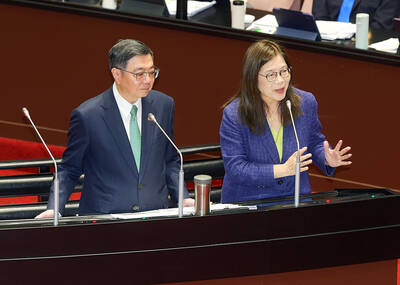
The donation of offshore patrol vessel Kinmen to the Philippines includes provisions that protect Taiwanese fishers and facilitate security cooperation across the First Island Chain, officials said yesterday. The comment was made during the Cabinet’s comprehensive administrative report at the legislature after Chinese Nationalist Party (KMT) Legislator Hsu Yu-chen (許宇甄) expressed concerns about the decision to give a ship to a country whose coast guard had in 2013 fired on a Taiwanese trawler and killed its captain without provocation. The Cabinet should lay out the safeguards that have been established to prevent the Philippine government from using the Kinmen to harass, expel
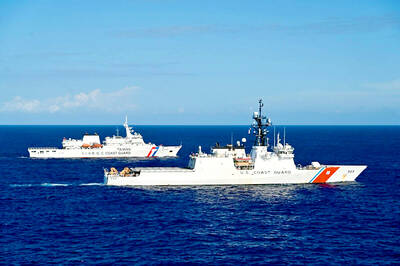
GROWING TIES: The CGA is planning a goodwill mission to the Philippines, in what would be the first time since 1975 a Taiwanese paramilitary vessel has visited the country The Coast Guard Administration (CGA) plans to significantly expand its participation in international security cooperative frameworks and its operational capabilities, a budget proposal for next year showed. The budget indicates a transformation of the CGA from a maritime law enforcement arm into a national defense and intelligence gathering entity capable of tackling larger regional security matters. The proposal showed that personnel from the coast guard’s Intelligence Division and Special Action Support Center are to participate in high-level national security talks with the US. As the CGA has dealt with China’s rising “gray zone” threats around Taiwan, it has become a valuable asset to
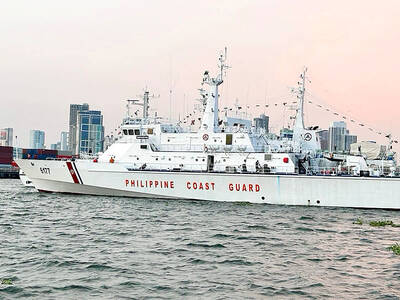
A patrol vessel donated by the Coast Guard Administration (CGA) to the Philippines was commissioned into the Philippine Coast Guard (PCG) on Friday, a Philippine non-governmental organization said. The CGA on Sept. 16 confirmed media reports that Taiwan had donated a retired 500-tonne patrol vessel to the Philippines. The Manila-based We Protect Our Seas (WPS) foundation, which served as an intermediary in the transfer, said that the vessel was formerly the CGA’s 500-tonne petrol vessel Kinmen (CG123). The WPS, in a statement issued on Friday, said the vessel, renamed as the BRP Sarangani, had been commissioned into the PCG the
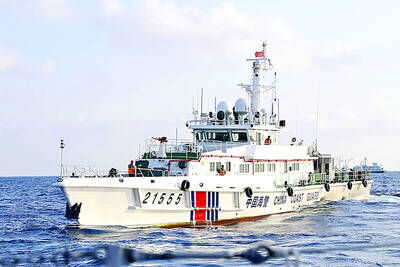
‘GRAY ZONE’ TACTICS: Beijing sent two China Coast Guard vessels to escort a ‘supposedly private research ship,’ a Philippine Coast Guard spokesman said The Coast Guard Administration (CGA) yesterday confirmed that it had recently deployed three patrol vessels to waters in Taiwan’s overlapping exclusive economic zone with the Philippines to monitor three Chinese vessels. CGA Deputy Director-General Hsieh Ching-chin (謝慶欽) said the agency regularly monitors Chinese vessels around Taiwan, and that the deployment south of Oluanpi (鵝鑾鼻), Taiwan proper’s southernmost point, was carried out in accordance with standard procedures. He added that the waters fall within the overlapping exclusive economic zones of Taiwan and the Philippines, which extend 200 nautical miles (370km) from their coastlines. Hsieh made the comments when asked about a


 RSS